Ch. 4: Repetition and Automatism

Before we explore habits, routines, autopilot, and ritual,
we must understand one simple truth: repetition is applied attention.
Everything that becomes automatic in our lives began as a moment of focus — a directed act, a learned gesture, a choice that repeated often enough to stop feeling like a choice.
We have much bigger influence over our inner architecture than we were ever taught. Repetition is a simple proof: every day is full of crossings back to ourselves.
In the previous chapter (The Architecture of Attention), we explored how attention shapes thought, perception, probability, and even physical motion.
Now we follow that thread into everyday life because the same attention that collapses quantum waves also collapses our days into patterns.
- Left unattended, repetition becomes unconscious.
- Trained deliberately, repetition becomes ritual.
This is where mental space meets daily life — in the small, repeated movements that determine whether we live by presence or by autopilot.
In this chapter we look at how attention, once crystallised through repetition, creates the structures we call habits — and how we can reclaim them.
Everyone has their own way of getting things done.
What sets us apart is how consciously we do that.
We already established that before anything can start, there has to be an idea – as an originating impulse that then branches out into full “hologram” of what this idea will bring about.
The way we process our inner dialogues and thoughts determines how conscious of what we are doing we can be in the doing.
Before anything becomes a habit,
before automatism takes over,
before rituals settle into grooves of repetition –
attention is what begins the path.
Its absence is what allows mimic loops.
Its presence is what restores balance.
This is why we start here.
Why is attention key in repetition?
Attention is the first architecture of the mental space –
the place where form begins.
But here is the paradox:
- When attention is not consciously held, it does not simply rest.
- It collapses into patterns.
Every mind that is not guided will default to repetition.
Not because we are flawed –
but because attention unused becomes attention captured.
This is the origin of automatism:
the mind runs the old tracks because nothing inside it is actively choosing new ones.
And so the question becomes:
- Do we place attention on purpose –
or does repetition place attention for us?
This is why the next step is crucial.
To understand habits, routines, and rituals,
we must first understand repetition,
because repetition is the natural gravity of an unguarded mind.
Autopilot: Doing Without Seeing
We often hear the phrase “on autopilot” to describe a specific way of doing things:
- to do something without focusing on it, without thinking about what is happening.
The state of autopilot enables habits, but is not limited to them alone.
Let’s clarify a key term:
Habits are settled or regular tendencies or practices, especially ones that are hard to give up.
They are often actions that are triggered automatically in response to contextual cues that have been associated with their performance.
So, while closely connected, autopilot and habit are not the same.
Why be so precise?
Because when we fall into autopilot or unconscious habit,
our mental fitness switches off.
Our attention floats from the moment of Now with those trains of thoughts that are always running – to whatever thoughts are there, dispersing our attention – often looping through scenarios that don’t even originate within us.
In other words:
without inner contact we become automata through being out of focused attention – while handling anything.
Repetition for its own sake – without intentional presence that would make it a conscious routine – generates auto-piloting, and conditions the mind into pattern-responses.
Systemic Effects and Examples – This has serious consequences:
Our current education systems encourage these very conditions:
- habituation without conscious knowing of it happening,
- obedience is more important than awareness and present attention,
- repetition as a fundament of all knowledge, which in this context replaces presence with pursuing success and expectations.
The result is widespread mediocrity, and deep apathy.
- “That’s how it is.”
- “One person can`t change anything.”
Submission that separates a man further from himself with each cut.
And at the same time this whole system feeds on narcissistic and ego-centric feedback loops that thrive on and adore such submissions.
This then in turn connects directly to:
- shortened concentration span,
- loss of ability to react to or memorize information,
- and above all, this connects directly to loss of ability to think holistically (objectively) or criticaly.
In other words,
we stop being able to cross-reference, re-sense, or reweave the moment.
Left-Handedness and Attention Conditioning
There is a simple, painful example of how early attention gets distorted through enforced repetition:
- for generations, left-handed children were forcibly trained to write with their right hand.
This wasn’t just inconvenience — it was a direct attack on the child’s natural motor coherence.
A left-handed child learns, from the very first letters, to split their attention:
- the natural (origin) part trying to follow their innate flow,
- the social part of child policing themselves to fit the expected standard.
- Their body says “This feels right,” while authority insists “This is wrong.”
- Their natural directionality becomes a point of shame.
This creates one of the earliest mimic loops:
inner knowing vs. outer obedience, where attention becomes divided –
not by nature, but by enforcement.
Repetition as Currency: Rewarding Obedience, Not Understanding
From the first hours of primary school, it becomes clear what is being rewarded:
- flawless repetition.
Not exploration.
Not interest.
Not connecting with an inner sense of truth.
What is rewarded is the precise reproduction of already-given content.
This creates an early divide between two kinds of children:
- Those who quickly sense what the teacher wants and repeat it obediently
– they become the system’s favourites: rewarded with praise, high grades, approval; - and those who follow their inner tone, ask additional questions, or simply cannot repeat on command, and are therefore quickly labelled as disruptive, unfocused, or even problematic.
And so the system establishes an internal compass-swap:
- The first group learns to measure their value through external reactions.
They use outer confirmation (grades, diplomas, smiles, points) as their navigation system. - The second group, labelled “different,”
later tries to prove their value in other ways:
through boldness, rebellion, over-adaptation, or even collapse.
But in every case often lose touch with their inner knowing.
The system thus does not create intelligent individuals.
It produces:
- pursuers of success and seekers of status,
- not autonomous beings with an inner compass.
In both cases — whether through adaptation or rebellion —
the inner compass is lost.
And that loss is the personal Field`s core wound.
We will explore this topic further in one of next writings,
The Great Error of Categorization,
where we will examine how such false standards have shaped entire societies.
From Repetition to Obedience: How a Soldier Is Formed
When we understand that repetition without understanding is not merely a learning strategy but a mechanism of internal disconnection, we can also see where that disconnection leads.
School systems that reward blind repetition create people who do not question — because questioning was never a safe option.
Those who insist on listening to their inner tone are, from early on, labelled as:
- problematic,
- slow,
- strange,
- unreliable.
Those who repeat without questions:
- advance,
- receive praise,
- become class leaders,
- and later — system operatives.
Over time, this dynamic reaches militant and totalitarian forms:
- Part of the drill for soldiers in an honour guard is that they must bark on command.
If they don’t — they’re out. - In intelligence agencies, selected individuals are trained to erase the inner voice — not just emotions, but their entire self-perception.
- In lodges and high-ranking brotherhoods, there is no space for doubt, only rules and their execution.
This is not extreme. It is the logical consequence of automatism.
- Every student who didn’t dare to say, “I don’t want to repeat this,” was a small stone in this pyramid.
- Every teacher who said, “That’s just how it has to be,” was its caretaker.
And every adult who later says,
“It’s not my fault, I’m just doing my job,”
is a soldier of the very system they helped build.
Mental States in Contrast
Let’s place some basic definitions:
- Common sense is a sound and prudent judgment based on a simple perception of the situation or facts.
- Critical thinking requires even more:
it is the ability to objectively analyze and evaluate the circumstances,
in order to form a clear oppinion.
When mental space is clogged with patterns,
both of these capacities collapse.
But: not all repetition is damaging.
The difference between mimic repetition,
which leads to automatism and de-personalization,
and tonal repetition, which restores contact, attunement,
and coherent recognition within the Field
is essential for understanding the entire distinction
between mimicry and the Field.
Two Types of Repetition: Obedience or Attunement
Repetition as a habit — no longer connected to presence —
is something entirely different from repetition as a method of alignment.
Repetition as habit is empty and on-demand:
- it is based on the expectation of an external response (grade, approval, belonging),
- it gradually drains inner orientation and replaces contact with reflex,
- it becomes a ritual without sacredness — an action without soul.
Repetition as a form of attunement is alive and responsive:
- it appears as a call-and-response between beings
who feel a shared thread or are seeking harmony, - it is not mere repetition, but tone-alignment —
when with a single tone you check whether the strings in the space resonate together, - it allows renewed contact with the true self —
through mirroring without coercion.
In the Field, as we are rediscovering it, there is nothing wrong with repetition —
when it comes from within:
- When a child says “mama” over and over, it is not a habit,
but a call for real relationship. - When two beings mirror each other, complement each other,
repeat a thought, refine an expression, check the rhythm…
This is not repetition for the sake of rules,
but a search for coherence within reality.
Repetition That Keeps the Thread Alive
I almost wrote, “All true songs contain repetitive elements,”
but the word “stories” is more accurate.
What motivated this correction is important for our narrative:
Songs — at least modern ones — have become empty structures of refrains,
where rhyme drips like a sugar candy without substance.
Everything repeats, but nothing moves.
This is no longer repetition as the rhythm of life, but repetition as a loop with no exit.

And yet — repetition itself is not the problem.
The problem is the absence of tone.
The Difference Between Rhythm and Spinning in Circles (a Loop):
All true stories contain repetitive elements:
- The forester walks into the forest again and again.
- The farmer plants her garden again and again.
- Water flows again whenever you remember it.
None of this is enslaving if it remains alive —
if it resonates within reality rather than repeating for its own sake.
This is how routines can actually save us:
- You stretch in the morning.
- You drink a glass of water before touching a screen.
- You check in with how you are.
- You go outside. You let the wind move you.
These are not automatisms.
These are the musical intervals of your presence.
The difference is not in the action, but in the awareness.
- When you walk the same path every day staring at the ground,
you are trapped. - When you walk the same path and each time see something new,
you are alive.
Repetition does not kill you.
The absence of attention kills you.
The absence of choice hardens you.
This is why even the simplest routine —
washing your hands, tidying a room, eating —
can become the smallest cell of your freedom,
if it is filled with inner presence.
The difference lies not in the action,
but in the awareness of the doing.

- Routine: conscious decision, even when it is not pleasant.
- Habit: automatic action, that subconsciously comfort us –
even when it influences us in degrading way.
“The difference between a routine and a habit: while routines might involve participation in tasks that aren’t enjoyable, we consciously choose to complete them because it seems to be the correct or necessary thing to do.
Habits, alternatively, give us some sort of subconscious satisfaction and we automatically perform them, even if it is actually bad for us.”
(from article 13 Facts and Differences Between Habits and Routines)
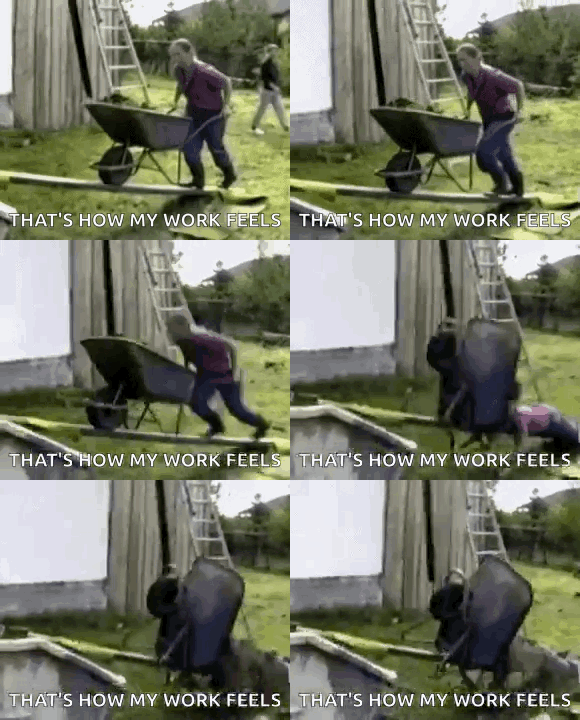
The man is doing the “right” thing, following a pre-set routine (the plank, the wheelbarrow) – but doesn’t pause to check what he’s actually doing.
Result?
Full load of consequences… straight to the head.
Just like mental autopilot: the habit might feel useful, but ends up backfiring.
Change in routine is like a change of tone –
when someone doesn`t change anything but rhythm –
and again meets themself through that.
From repetition to ritual: the fork in the path
At this point, we can see the structure clearly:
- Autopilot is repetition without presence.
- Habit is repetition without awareness.
- Routine is repetition with minimal awareness.
All three share the same engine:
the mind repeats what is familiar, whether it serves us or harms us.
But not all repetition is the same.
There is a moment — small, but decisive — where repetition can rise into something else entirely.
When attention returns, when breath becomes part of the action,
when awareness enters the movement…
repetition becomes rhythm.
And rhythm is the gateway to ritual.
This is the spiral turn, the moment a mechanical loop becomes a conscious pulse.
This is where automatism can transform into meaning.
Which brings us to the most fundamental distinction in practical life:
the difference between a routine and a ritual.
Now we’ve explored habits, routines, and the state of autopilot –
but there’s another form of repetition that carries a completely different quality:
a ritual.
A ritual may appear externally similar to a routine –
but the inner tone is utterly different.
A routine is an action done without specific attention, and is often linked to efficiency, convenience, or habit. It is prone to mechanical repetition, easily co-opted by autopilot, and is hence vulnerable to mimic loops when done unconsciously – it quickly becomes lifeless.
Mimics love routines.
They thrive on automated repetition, on surfaces that move without presence or attention. They use routine to simulate life – without ever living it.
But the Field doesn`t respond to simulation.
It responds to rhythm, attention – breath, and authenticity.
A true ritual is never a dead form –
it is a living pulse, an invitation to presence.
A moment of return.
So, a ritual is a consciously repeated action with full intent.
It holds rhytm, not automation.
It re-embodies us.
It carries presence, breath, and awareness,
It generates Field of contact, rather than merely flowing in one,
and it seeks not efficiency, but depth.
Take this example:
Drinking your morning coffee can be a routine — or a ritual.
It can be an escape from emptiness —
or a moment of breath, silence, and self-conversation –
a moment of return to presence.
Most important difference in our attitudes is definitely whether we are consciously going through situations.
In other words, this means:
- do we make decisions in all awareness based on what we consider to be best solution regarding given situation and available information,
- or do we just go with the flow of whatever, an impulse, some outside influence, or some other roadside attraction that causes mindless approach or attitude/behavior.
Every habit, every routine, every unconscious gesture is a stored decision — a memory of a choice we once made.
The power lies not in destroying these patterns, but in recognizing them, reclaiming them, and choosing again.
- Repetition is not the enemy.
- Autopilot is not a flaw.
They are simply what happens when attention leaves and the mind keeps walking on its own.
- Ritual is repetition returned to presence.
- Habit is repetition emptied of presence.
When we restore attention to the smallest act — to a breath, to a gesture, to a meal, to a moment of silence — the mind begins to remember itself.
Mental space becomes clear.
Life becomes participatory again.
This is the entire world of difference.
A Bite of Automatism
If you want to know how deeply automatism is anchored in the modern human being,
take away the five foods they are used to eating every week.
Not by taking away food itself — just change the items that repeat.
Immediately you will see:
- panic,
- blame,
- and a completely lost compass.
We are a generation that no longer knows how to eat if there is no label.
When there is no screen. No sugar. No validation.
- Without the ritual of repetition that has become a substitute for safety.
Food today is one of the most precise indicators of our disconnection —
and one of the most important keys to regeneration.
But we will open that door in one of the next pieces — in the next segment, where we will go right to the bone.
Repetition as the Natural Way of Learning
In its original form, learning was always rooted in curiosity, exploration, and the inner desire to understand.
When repetition arises from a genuine desire for contact — with knowledge, with the body, with music, with others — then it is not mechanical, but attuning.
A child who asks “why” five times in a row is not trying to manipulate or disturb anyone —
with each question, they are trying to align their inner world with the outer one.
In the same way, a musician who repeats the same note does not seek perfection —
but recognition.
Touch. Contact. Exactly that tone.
When this kind of repetition is understood, it does not lead to automatism —
but to deeper presence.
That is why the difference between liberating and enslaving repetition lies in the tone of the intent.
If the center remains in the being, in contact, in relationship —
then every repeated step is a new spiral,
not an old loop.