Ch. 2: The Forgotten Realm of Power, Memory and Manipulation

Natural Logic
Most fascinating fact about everything is that mental environment is actually the realest one – the fundamental one.
It is the environment where everything appears first, the place of origin of everything, and the place of knowing.
And there is logic in it – logic that is applicable in any given situation, because it is bound by laws that never change, because they are the laws of existence itself. Like the simple (and very limited) example of action and reaction, or in other words, action and consequence.

Through this law it is easy to see how “as above, so below” works.
Most important to keep in mind here is:
these laws are effective on all levels of existence, tangible and intangible, micro and macro, between individual and the collective.
These are the foundations of our individual mental castles, and our collective metropolis. And it goes further, because logic is always logical and follows truth, because black cannot be white and nothing is ever lost.
There are situations that we know by term paradox which are specific, but let us not get into this just yet – a good graphic will do for now.
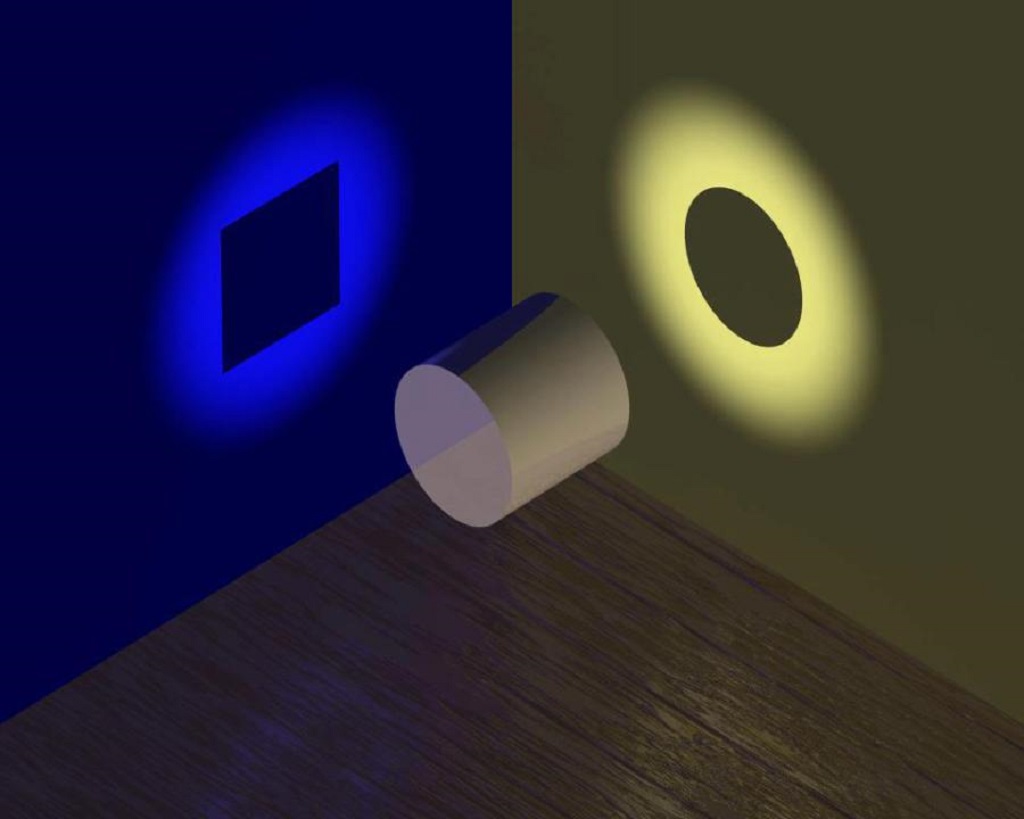
Such disputes cause wars!
What we call paradox is often just a matter of angle. A shape lit from one side casts a circle, from another a square — is it contradiction, or a deeper form?
The infinity sign is another such illusion.
Flattened in two dimensions, it appears as an endless loop. But seen from another angle, it is a slice of a torus.
And beyond that — a momentary glimpse of a living spiral.
One slice gives the donut. Another, the loop.
But only the spiral carries the Field forward.
What Fills The Mental Space?
Some Definitions and Key Differences:
The most basic forms in mental space are thoughts.
They arise and fall — like waves in the sea.
So, what is a thought?
A thought is an event in the mental space, like a passing spark – a ripple in mental space, often fleeting, reactive, and triggered by stimuli.
Most of these events are passive or echo-based, and can be random, habitual, associative or even borrowed.
They can also be observed, ignored, dismissed, or looped.
And, most importantly – thoughts are formless unless shaped by attention.
An idea, however, is something more: it is a shaped thought, one that has gathered coherence, intention, and form.
A table to see the difference more clearly:
| Thought | Idea |
| movement | structure |
| moment | memory-in-form |
| spark | seed |
And, what is an idea exactly?
It is a formed structure in mental space which carries inner coherence, purpose, or potential, but also has a center, a direction, and a shape.
It can be original or inherited, but it gathers force over time in all circumstances.
Ideas are constellations — stable enough to build around.
Based on ideas, it is possible to generate and anchor decisions, decide on and shape actions, build systems, and even worlds. – An idea can anchor a whole field of reality.
Ideas can also attract further thoughts around them.
A single idea can become a law, a house, a field — or a world.
That’s why the architecture of ideas is so important: because the Field responds to structure – not to noise.
From An Idea to Whole House
Simple example of how everything starts out in the mental space to manifest in our practical shared reality is building a house.
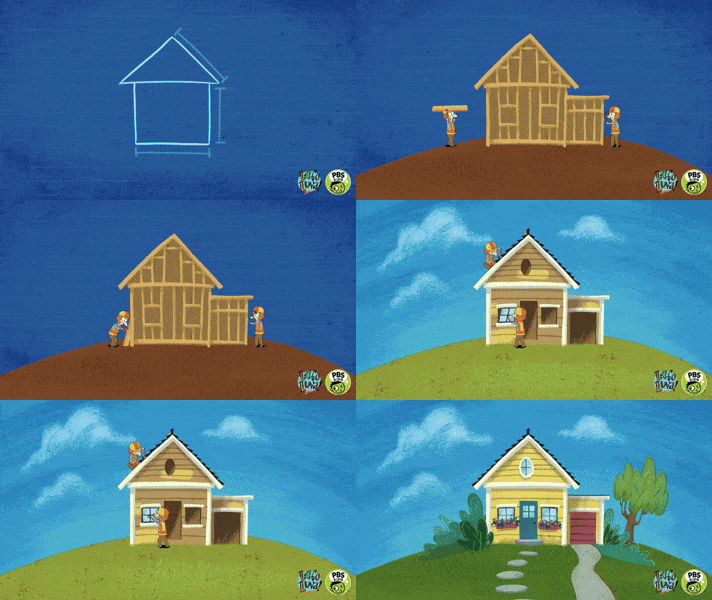
How would someone build a house if they had not planned it first, starting with a thought, and then an idea of a house as such in the first place?
Not to mention that an idea of a house just by itself does not suffice — there has to be a logical process, a construct of ideas, to get to a whole plan of how to actually start the building: what kind of house, how much space and rooms, in what order, where and with what materials, and which men of craft would be required, etc.
A whole lot of mental activity — planning and decision-making on many levels — has to take place before first practical activity can be properly performed in our practical shared reality.
After the basic idea of a house appeared, the first practical activity would then be the first manifestation of the idea of the house in the physical reality.
Each idea by itself is an action and brings consequence/response, hence having constructs of ideas brings constructs of consequences/responses.
Every single object, or form (body) that exists, or concept, or rule — everything starts out as an idea, and then manifests as something that brings consequence to shared reality, materially as an object or a form, and mentally as a notion, an idea or a rule for example.

It is plain to see that it is important what kind of input we contribute to our collective. Every thought matters, and every action and its consequence matters. Also, everything created exists and nothing is ever lost, so the only constant through the spiraling cycles is change.
From Ideas to Bodies
To show a more complicated example: everyone who resides here in a body, in form, that was born into a form that now lives and exists, did this through a process similar to that of building a house — but with much more detailed, more advanced type of creation procedure.
Life was created, not just a static object. From an idea with will and intent, through cooperation with other living aspects, each of us formed a vehicle, a body, to use and maintain to be able to be present in physical world of shared reality.
Yes, it is a very very simplified explanation, but correct nevertheless. There is a miracle if you ever needed to encounter one…

In turn, our Sun and Earth etc. are also conscious beings — or they, like all other objects in physical reality, could not exist.
Did you see how we just lost all the need for middlemen and interpreters of riddled fake past and traditions? It is simple logic. It just has to be considered one step at a time.
However, there is a stark contrast between the natural logic and Law and the modern interpretation of terms we discuss here.
Law as the Fabric of Existence
Definition of modern law: https://www.britannica.com/topic/law
The discipline and profession concerned with the customs, practices, and rules of conduct of a community that are recognized as binding by the community.
But what is a community?
Definition of community: https://en.wikipedia.org/wiki/Community
A group of people living in the same place, or sharing a particular characteristic in common — and the state (or even imposed condition) of sharing certain attitudes or interests.
And here we must pause.
Because…
What if this “same place”, or these “particular characteristics in common”,
are something we now know little or nothing about?
What if the deepest threads of our shared place – and shared being –
have been hidden from us on purpose?
For generations, much has been done to keep us blind, deaf, and senseless.
To keep us mentally kneeling, separated, and afraid of each other.
But we are remembering – Equality and Law.
When we come into form – born alive as men and women – we are, by that very breath, equal before Law and Existence.
No one stands above another.
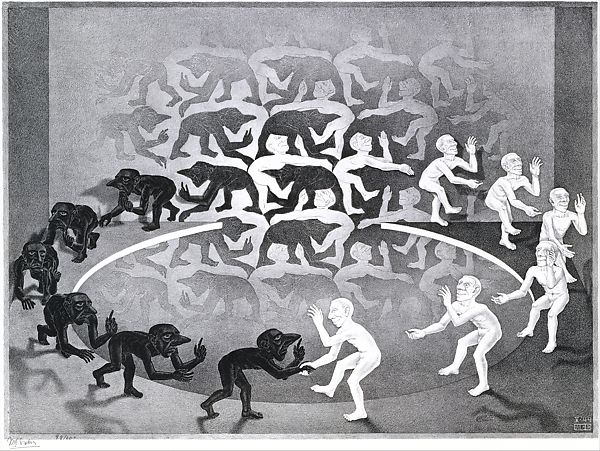
In our original state, we recognize everything around us as equal – especially those parts of existence that move and speak of hidden things, of aspects further away, yet still part of us.
We are not only granted the right to exist – we carry the responsibility to be here:
to live, to witness, and to serve as custodians of our shared reality
or, in more familiar words, our beautiful planet.
And we have free choice.
The will to act as we would wish others to act toward us —
not just in survival, but in service to the betterment of all Life.
Let that be the Law, let that be the remembrance:
Law is inherently bound to existence.
If there were no law, existence itself could not continue.
What happened – the Butterfly Effect in action
So agreements appear to be constructs in mental space, and we live in a society of many agreements and theories, so many that we take them to be facts just because they are so widely accepted and enforced through systemic institutions and through peer pressure further on.
Or rather, because we believe they are there for a (and because of) reason and that they are proper just because we were born into situation, because we were imprinted with most of them through whole of society already acting according to them.
Definition of an agreement:
harmony or accordance in opinion or feeling; also a negotiated and typically legally binding arrangement between parties as to a course of action; also the absence of incompatibility between two things; consistency.

the Butterfly Effect in action.
One great example of this are borders, because borders, as we all know, exist on basis of agreements. Or at least they should.
Borders are a good example of how a purely mental construct manifests in shared reality and brings severe influences to it, with very physical and societal consequences.
Constructs and Theories Become Facts
Definition of a Construct:
An idea or theory containing various conceptual elements, typically one considered to be subjective and not based on empirical evidence; also build or make (something, typically a building, road, or machine).
This must also be how various theories were accepted as facts — like Evolution Theory for Homo sapiens species, for instance — although they be just ideas, theories. It is very similar with the well known phenomenon of time.
This is also something worth looking into, as an agreement and a concept, because the notion of time has been too simplified on one hand and made too complex on the other.
Certain parts of our collective have been cheating through history and stole the original settings for everything — most importantly our memory/knowingness of our origins and state of being, and law, which sort of make up the notion of time.

These parts of our collective use time as an egregore, they have created things such as calendars, clocks, schedules… A whole layer of reality – to bind others into a conviction of necesity of these structures.
Even so, it would be more true to say we speak of and refer to spiral cycles — which are again a part of existence itself and as such bound by the same laws as the whole of existence — than to say we speak of and refer to time. Yet what we really mean are not closed cycles at all, but slices that together form a greater spiral.
This spiral was attempted to be derailed into cycles more than once, but true existence never repeats itself. Where Ouroboros eats its own tail is where the crossing to new levels of the spiral occur.
Nothing happens twice exactly the same — each turn is new, even if it feels familiar. What we call cycles are glimpses of movement along a spiral that is always unfolding – in the mutual Song on the waves of Never Not.
Why People Feel They Have No Time
People rarely stop to think about these subjects, and it is plain to see why.
Pressure to live fast is ever increasing: there is so much to do and so little time… Because of societal pressure, and all these new/old viruses and war-mongering, and ordinary day-to-day life, with ordinary day-to-day chores, tasks and worries. Because of peer pressure, existential crises, family disputes.

Also working nine-to-five at least five days per week (or other arrangements people use to earn for their costs of living), and caring for their children. Surely more could be added here, but it should be enough to make a point.
And consequentially, rare people (or rather no one) teaches children about mental space and its rules.
On the contrary, our society molds children’s spirits and natural intelligence to fit the malfunctioning system that runs on completely unnatural tendencies of greed and power-mongering.

The line is thin when repetition replaces curiosity
Education is based on repetition and more repetition, demanding from students that all have same thought processes and abilities, as well as obedience with no critical thinking — or they be labeled maladjusted and unfit.
This is what I was referring to when I wrote that so much effort is put into this system`s expectation of molding by children, so much self-denial and self-sacrifice, that we all defend what we had to fight for so hard. And it was done on purpose, just so we would not be able to free ourselves.
Please, consider this.
Tending the Garden of the Mind
We often speak of sovereignty and freedom — but what does that look like in real time?
It begins here: not in law courts, or politics, or revolution. But in the quiet space between thoughts. In the moment before reaction. In the choice of where to place attention.
This is where the reclamation begins. – It’s not flashy. It’s not fast. But it’s real.
One of the clearest and most grounded practices for this kind of inner clearing was described decades ago by Franz Bardon.
He called it thought discipline — a simple, structured approach to mental hygiene and presence. No belief system required. Just a willingness to observe what moves inside the mind, without being moved by it.
This is the first exercise:
Sit for a few minutes each day and observe your thoughts without judgment or attachment.
Watch them rise and fall.
Do not follow them, do not fight them.
Just witness – this alone begins the shift.
It sounds easy. It isn’t.
But it’s the kind of inner strength the system was designed to erase – because it returns choice to the being, moment by moment.
We will return to this in more depth, but for now, the invitation is simple:
Notice your thoughts.
Decide what belongs.
Choose what you keep alive.
Your mental space is not a dumping ground.
It is a seedbed.
It is time to weed, water, and replant it wisely.